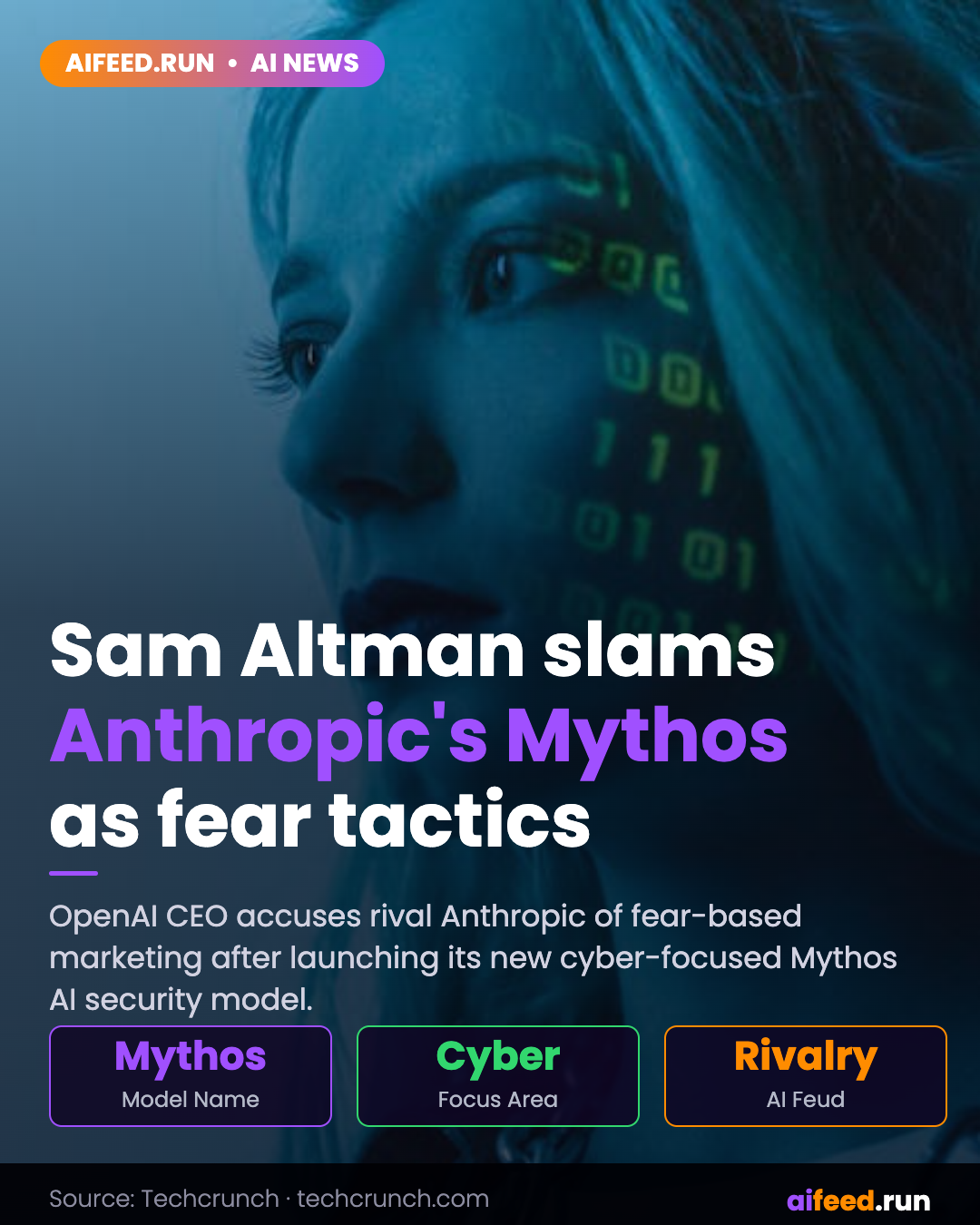
Sam Altman throws shade at Anthropic's cyber model, Mythos: 'fear-based marketing'
· Industry
The competitive dynamics between frontier AI labs just took a sharper turn.
The competitive dynamics between frontier AI labs just took a sharper turn. Sam Altman publicly criticized Anthropic's newly launched cyber-focused model, Mythos, accusing the company of leveraging fear-based marketing to drive attention and adoption.
The critique cuts to an ongoing tension in the industry: where does legitimate safety communication end, and where does threat-amplification as a go-to-market strategy begin? Anthropic has consistently positioned itself as the safety-forward lab, and Mythos extends that narrative into the enterprise cybersecurity domain.
For enterprise buyers, the dispute matters. Security procurement decisions increasingly hinge on how vendors frame risk — and models marketed around worst-case threat scenarios can shape budget allocation, compliance posture, and board-level conversations in outsized ways.
Altman's remarks also reflect OpenAI's own strategic positioning. By pushing back on fear-led narratives, the company is signaling a preference for capability and productivity framing over existential messaging — a meaningful differentiator as both labs court Fortune 500 contracts.
Expect this debate to escalate. As AI capabilities intersect more deeply with cybersecurity, offensive research, and national security, how labs communicate risk will become as scrutinized as the models themselves.
`;
}
// ─── HELPERS ─────────────────────────────────────────────────────────
function escHtml(s) { return String(s == null ? '' : s).replace(/&/g,'&').replace(/"/g,'"').replace(//g,'>'); }
function storyImg(p, cls, sizes) {
const url = p.imageUrl || '';
if (!url) return ``;
const m = /^(?:https:\/\/aifeed\.run)?\/?images\/([^\/?#]+)\.(?:png|jpe?g|webp)$/i.exec(url);
const alt = escHtml(p.headline || 'AI news story');
if (!m) return ``;
const t = '/thumbs/' + m[1];
return ``;
}
function imgFallback(el) {
if (!el.dataset.fb) { el.dataset.fb = '1'; el.removeAttribute('srcset'); el.src = el.dataset.full; }
else { el.style.visibility = 'hidden'; }
}
function formatDate(iso) {
if (!iso) return '';
return new Date(iso).toLocaleDateString('en-US', { month: 'long', day: 'numeric', year: 'numeric' });
}
function handleSubscribe(e) {
e.preventDefault();
const email = document.getElementById('inline-email').value;
e.target.reset();
goSubscribe(email, 'article');
}
// One step: the email typed on the page goes straight to Beehiiv's confirm page (no second form).
function goSubscribe(email, source) {
window.__subSource = source;
const url = 'https://magic.beehiiv.com/v1/eb0b9508-1ffd-4fb1-a63c-e762fa86569c?email=' + encodeURIComponent(email)
+ '&utm_source=aifeed.run&utm_medium=website&utm_campaign=' + encodeURIComponent(source || 'site');
// Same tab (no popup: in-app browsers like Instagram's prompt on new windows); Beehiiv sends the visitor to our thanks page after the one tap.
window.location.href = url + '&redirect_to=' + encodeURIComponent('https://aifeed.run/subscribe/thanks/'); return;
try { w.opener = null; } catch (err) {}
document.getElementById('sub-email-field').value = email;
document.getElementById('sub-form-state').style.display = 'none';
document.getElementById('sub-success-state').style.display = 'block';
document.getElementById('sub-overlay').style.display = 'flex';
document.body.style.overflow = 'hidden';
}
function openSubOverlay(email) {
document.getElementById('sub-email-field').value = email;
document.getElementById('sub-form-state').style.display = 'block';
document.getElementById('sub-success-state').style.display = 'none';
document.getElementById('sub-btn').textContent = 'Subscribe — It\'s Free →';
document.getElementById('sub-btn').disabled = false;
document.getElementById('sub-overlay').style.display = 'flex';
document.body.style.overflow = 'hidden';
}
const BEEHIIV_SUBSCRIBE_URL = 'https://magic.beehiiv.com/v1/eb0b9508-1ffd-4fb1-a63c-e762fa86569c'; // Beehiiv public Magic Link for AIFeed.run (pub_eb0b9508-…), no API key
async function submitSubscribe(e) {
e.preventDefault();
const email = document.getElementById('sub-email-field').value;
const btn = document.getElementById('sub-btn');
btn.textContent = 'Opening signup...';
btn.disabled = true;
// Opens Beehiiv's one-click confirm page for this email ("You'll be subscribed with …"). No secret client-side.
const bhUrl = BEEHIIV_SUBSCRIBE_URL + '?email=' + encodeURIComponent(email)
+ '&utm_source=aifeed.run&utm_medium=website&utm_campaign=' + encodeURIComponent(window.__subSource || 'site');
// Same tab (no popup: in-app browsers like Instagram's prompt on new windows); Beehiiv sends the visitor to our thanks page after the one tap.
window.location.href = bhUrl + '&redirect_to=' + encodeURIComponent('https://aifeed.run/subscribe/thanks/'); return;
try { w.opener = null; } catch (err) {}
document.getElementById('sub-form-state').style.display = 'none';
document.getElementById('sub-success-state').style.display = 'block';
}
function closeSubOverlay(e) {
if (e && e.target && e.target.id !== 'sub-overlay' && e.target.id !== 'sub-close-btn') return;
document.getElementById('sub-overlay').style.display = 'none';
document.body.style.overflow = '';
}
function copyLink() {
navigator.clipboard.writeText(window.location.href).then(() => {
const t = document.getElementById('toast');
t.textContent = '🔗 Link copied!';
t.classList.add('show');
setTimeout(() => t.classList.remove('show'), 2500);
});
}
function showToast() {
const t = document.getElementById('toast');
t.textContent = '🎉 You\'re subscribed! Welcome to the feed.';
t.classList.add('show');
setTimeout(() => t.classList.remove('show'), 3500);
}
function getDemoPosts() {
return [
{
id: 'demo-1', slug: 'apple-building-ai-glasses-beat-meta',
headline: 'Apple Is Building AI Glasses To Beat Meta',
summary: 'No screen. Just AI, cameras, and Siri. 4 designs. Premium acetate. Ships 2027.',
body: '
Apple is reportedly developing AI-powered smart glasses designed to compete directly with Meta\'s Ray-Ban AI glasses — and the early details are compelling.
Unlike the Vision Pro, these will have no display at all. Instead, they\'ll rely entirely on AI processing: cameras, Siri integration, and ambient computing. Four frame styles are planned, with premium acetate construction targeting a fashion-forward audience.
The $499 starting price positions them as a premium-but-accessible device — significantly cheaper than Vision Pro but pricier than Meta\'s Ray-Bans. A 2027 launch window gives Apple time to refine the AI stack that will power them.
This move signals Apple\'s belief that ambient AI wearables — not VR headsets — will be the mainstream computing interface of the next decade.
',
category: 'Products', hashtags: ['apple', 'AIglasses', 'meta', 'wearables'],
publishedAt: new Date().toISOString(), imageUrl: ''
},
{
id: 'demo-2', slug: 'google-gemma-4-free-ai-lives-on-phone',
headline: 'Google Gemma 4: Free AI That Lives On Your Phone',
summary: 'Runs locally. Chats never saved. No cloud. Free on iOS and Android right now.',
body: '
Google has released Gemma 4, its most capable on-device AI model yet — and it\'s free on both iOS and Android.
The key differentiator: everything runs locally. Your conversations never leave your device, never hit a server, and are never stored. For privacy-conscious users, this is a significant shift.
Performance gains are substantial. Gemma 4 is reportedly 4x faster than its predecessor and uses 60% less battery — critical specs for a model running continuously on mobile hardware. Google claims it reaches 140 million Android devices immediately at launch.
This puts real competitive pressure on Apple Intelligence and signals that on-device AI is no longer a compromise — it\'s becoming the preferred architecture for consumer AI.
',
category: 'Models', hashtags: ['google', 'gemma', 'mobileAI', 'privacy'],
publishedAt: new Date(Date.now() - 86400000).toISOString(), imageUrl: ''
},
{
id: 'demo-3', slug: 'agi-will-hit-10-revolutions-one-decade',
headline: 'AGI Will Hit Like 10 Revolutions In One Decade',
summary: 'Leading researchers now agree: AGI arrival will compress a century of change into ten years.',
body: '
The consensus among leading AI researchers is shifting from "if" to "when" — and increasingly, the answer is "soon."
A growing number of labs now believe AGI will compress decades of civilizational change into a single decade. Not one industrial revolution, but ten — simultaneously — across medicine, energy, materials science, software, and beyond.
This framing is gaining traction not as hyperbole but as a calibrated forecast from people with direct access to the most capable systems being built today.
What changes first: knowledge work. Then physical labor. Then scientific research itself. The sequencing matters less than the speed.
 `;
}
function imgFallback(el) {
if (!el.dataset.fb) { el.dataset.fb = '1'; el.removeAttribute('srcset'); el.src = el.dataset.full; }
else { el.style.visibility = 'hidden'; }
}
function formatDate(iso) {
if (!iso) return '';
return new Date(iso).toLocaleDateString('en-US', { month: 'long', day: 'numeric', year: 'numeric' });
}
function handleSubscribe(e) {
e.preventDefault();
const email = document.getElementById('inline-email').value;
e.target.reset();
goSubscribe(email, 'article');
}
// One step: the email typed on the page goes straight to Beehiiv's confirm page (no second form).
function goSubscribe(email, source) {
window.__subSource = source;
const url = 'https://magic.beehiiv.com/v1/eb0b9508-1ffd-4fb1-a63c-e762fa86569c?email=' + encodeURIComponent(email)
+ '&utm_source=aifeed.run&utm_medium=website&utm_campaign=' + encodeURIComponent(source || 'site');
// Same tab (no popup: in-app browsers like Instagram's prompt on new windows); Beehiiv sends the visitor to our thanks page after the one tap.
window.location.href = url + '&redirect_to=' + encodeURIComponent('https://aifeed.run/subscribe/thanks/'); return;
try { w.opener = null; } catch (err) {}
document.getElementById('sub-email-field').value = email;
document.getElementById('sub-form-state').style.display = 'none';
document.getElementById('sub-success-state').style.display = 'block';
document.getElementById('sub-overlay').style.display = 'flex';
document.body.style.overflow = 'hidden';
}
function openSubOverlay(email) {
document.getElementById('sub-email-field').value = email;
document.getElementById('sub-form-state').style.display = 'block';
document.getElementById('sub-success-state').style.display = 'none';
document.getElementById('sub-btn').textContent = 'Subscribe — It\'s Free →';
document.getElementById('sub-btn').disabled = false;
document.getElementById('sub-overlay').style.display = 'flex';
document.body.style.overflow = 'hidden';
}
const BEEHIIV_SUBSCRIBE_URL = 'https://magic.beehiiv.com/v1/eb0b9508-1ffd-4fb1-a63c-e762fa86569c'; // Beehiiv public Magic Link for AIFeed.run (pub_eb0b9508-…), no API key
async function submitSubscribe(e) {
e.preventDefault();
const email = document.getElementById('sub-email-field').value;
const btn = document.getElementById('sub-btn');
btn.textContent = 'Opening signup...';
btn.disabled = true;
// Opens Beehiiv's one-click confirm page for this email ("You'll be subscribed with …"). No secret client-side.
const bhUrl = BEEHIIV_SUBSCRIBE_URL + '?email=' + encodeURIComponent(email)
+ '&utm_source=aifeed.run&utm_medium=website&utm_campaign=' + encodeURIComponent(window.__subSource || 'site');
// Same tab (no popup: in-app browsers like Instagram's prompt on new windows); Beehiiv sends the visitor to our thanks page after the one tap.
window.location.href = bhUrl + '&redirect_to=' + encodeURIComponent('https://aifeed.run/subscribe/thanks/'); return;
try { w.opener = null; } catch (err) {}
document.getElementById('sub-form-state').style.display = 'none';
document.getElementById('sub-success-state').style.display = 'block';
}
function closeSubOverlay(e) {
if (e && e.target && e.target.id !== 'sub-overlay' && e.target.id !== 'sub-close-btn') return;
document.getElementById('sub-overlay').style.display = 'none';
document.body.style.overflow = '';
}
function copyLink() {
navigator.clipboard.writeText(window.location.href).then(() => {
const t = document.getElementById('toast');
t.textContent = '🔗 Link copied!';
t.classList.add('show');
setTimeout(() => t.classList.remove('show'), 2500);
});
}
function showToast() {
const t = document.getElementById('toast');
t.textContent = '🎉 You\'re subscribed! Welcome to the feed.';
t.classList.add('show');
setTimeout(() => t.classList.remove('show'), 3500);
}
function getDemoPosts() {
return [
{
id: 'demo-1', slug: 'apple-building-ai-glasses-beat-meta',
headline: 'Apple Is Building AI Glasses To Beat Meta',
summary: 'No screen. Just AI, cameras, and Siri. 4 designs. Premium acetate. Ships 2027.',
body: '