Physical AI Moves Closer to Factory Floors as Companies Test Humanoid Robots
· Hardware
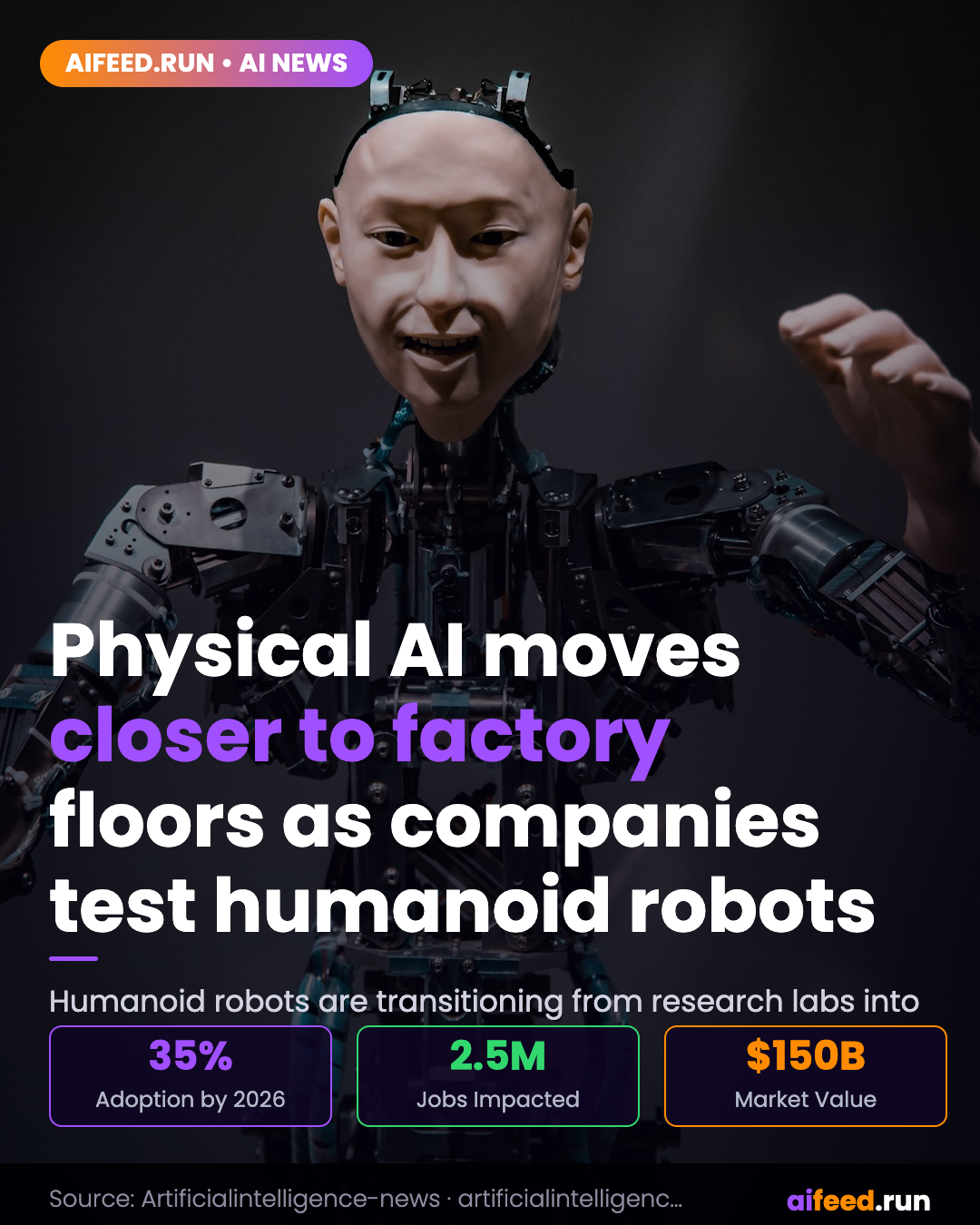
Humanoid robots are entering real factory production lines as physical AI systems hit the reliability threshold for industrial deployment.
Humanoid robots are moving from innovation labs directly into factory production lines—and this shift signals a fundamental turning point in industrial automation.
Several major manufacturers are now conducting live trials of humanoid robots on actual production floors. This represents a critical inflection point: physical AI systems have reached the reliability threshold needed for real-world deployment. The convergence of improved robotics hardware, sophisticated AI algorithms, and urgent labor-market pressures has created the perfect storm for widespread adoption. Companies that were skeptical just 18 months ago are now actively piloting these systems at scale.
From a business perspective, the economics are becoming impossible to ignore. Humanoid robots can perform complex, dexterous tasks that previously required human workers—operating machinery, assembling components, quality inspection. Unlike task-specific automation, humanoid robots offer flexibility: they can be retrained for different roles, adjusted to existing workflows, and deployed across multiple production lines. The capital investment is substantial, but operational cost savings are compelling.
For investors and strategists, this creates both opportunity and urgency. Companies leading humanoid robot deployment will gain structural competitive advantages in labor costs, consistency, and 24/7 productivity. Industries with high labor turnover, repetitive-yet-complex tasks, and tight margins will see adoption accelerate fastest.
Broader AI industry implications are profound. We're transitioning from "digital AI" (software, data processing) to "embodied AI" (physical interaction with the world). This expansion massively increases the addressable market for AI applications and creates new categories of competitive advantage based on robotics capabilities, not just software.
The next 2-3 years will be decisive. Early adopters will establish the operational playbooks that others follow. The question isn't whether humanoid robots will transform manufacturing—it's which companies will lead that transformation.
Source: Artificial Intelligence News · https://www.artificialintelligence-news.com/news/physical-ai-humanoid-robots-factories/
Source: AI News
More AI news
- xAI Introduces Grok Build, Its AI Coding Agent
- Fervo Energy's $10B IPO Signals Geothermal Energy as the Solution to AI's Power Crisis
- SoftBank Posts $46 Billion Gain at Vision Fund Driven Mainly by Massive OpenAI Bet
- WhatsApp Adds Meta AI Chats That Are Built to Be Fully Private
- SoftBank posts $46 billion gain at Vision Fund driven mainly by massive OpenAI bet
- Jensen Huang to college grads: "Run. Don't walk" toward AI
 `;
}
function imgFallback(el) {
if (!el.dataset.fb) { el.dataset.fb = '1'; el.removeAttribute('srcset'); el.src = el.dataset.full; }
else { el.style.visibility = 'hidden'; }
}
function formatDate(iso) {
if (!iso) return '';
return new Date(iso).toLocaleDateString('en-US', { month: 'long', day: 'numeric', year: 'numeric' });
}
function handleSubscribe(e) {
e.preventDefault();
const email = document.getElementById('inline-email').value;
e.target.reset();
goSubscribe(email, 'article');
}
// One step: the email typed on the page goes straight to Beehiiv's confirm page (no second form).
function goSubscribe(email, source) {
window.__subSource = source;
const url = 'https://magic.beehiiv.com/v1/eb0b9508-1ffd-4fb1-a63c-e762fa86569c?email=' + encodeURIComponent(email)
+ '&utm_source=aifeed.run&utm_medium=website&utm_campaign=' + encodeURIComponent(source || 'site');
// Same tab (no popup: in-app browsers like Instagram's prompt on new windows); Beehiiv sends the visitor to our thanks page after the one tap.
window.location.href = url + '&redirect_to=' + encodeURIComponent('https://aifeed.run/subscribe/thanks/'); return;
try { w.opener = null; } catch (err) {}
document.getElementById('sub-email-field').value = email;
document.getElementById('sub-form-state').style.display = 'none';
document.getElementById('sub-success-state').style.display = 'block';
document.getElementById('sub-overlay').style.display = 'flex';
document.body.style.overflow = 'hidden';
}
function openSubOverlay(email) {
document.getElementById('sub-email-field').value = email;
document.getElementById('sub-form-state').style.display = 'block';
document.getElementById('sub-success-state').style.display = 'none';
document.getElementById('sub-btn').textContent = 'Subscribe — It\'s Free →';
document.getElementById('sub-btn').disabled = false;
document.getElementById('sub-overlay').style.display = 'flex';
document.body.style.overflow = 'hidden';
}
const BEEHIIV_SUBSCRIBE_URL = 'https://magic.beehiiv.com/v1/eb0b9508-1ffd-4fb1-a63c-e762fa86569c'; // Beehiiv public Magic Link for AIFeed.run (pub_eb0b9508-…), no API key
async function submitSubscribe(e) {
e.preventDefault();
const email = document.getElementById('sub-email-field').value;
const btn = document.getElementById('sub-btn');
btn.textContent = 'Opening signup...';
btn.disabled = true;
// Opens Beehiiv's one-click confirm page for this email ("You'll be subscribed with …"). No secret client-side.
const bhUrl = BEEHIIV_SUBSCRIBE_URL + '?email=' + encodeURIComponent(email)
+ '&utm_source=aifeed.run&utm_medium=website&utm_campaign=' + encodeURIComponent(window.__subSource || 'site');
// Same tab (no popup: in-app browsers like Instagram's prompt on new windows); Beehiiv sends the visitor to our thanks page after the one tap.
window.location.href = bhUrl + '&redirect_to=' + encodeURIComponent('https://aifeed.run/subscribe/thanks/'); return;
try { w.opener = null; } catch (err) {}
document.getElementById('sub-form-state').style.display = 'none';
document.getElementById('sub-success-state').style.display = 'block';
}
function closeSubOverlay(e) {
if (e && e.target && e.target.id !== 'sub-overlay' && e.target.id !== 'sub-close-btn') return;
document.getElementById('sub-overlay').style.display = 'none';
document.body.style.overflow = '';
}
function copyLink() {
navigator.clipboard.writeText(window.location.href).then(() => {
const t = document.getElementById('toast');
t.textContent = '🔗 Link copied!';
t.classList.add('show');
setTimeout(() => t.classList.remove('show'), 2500);
});
}
function showToast() {
const t = document.getElementById('toast');
t.textContent = '🎉 You\'re subscribed! Welcome to the feed.';
t.classList.add('show');
setTimeout(() => t.classList.remove('show'), 3500);
}
function getDemoPosts() {
return [
{
id: 'demo-1', slug: 'apple-building-ai-glasses-beat-meta',
headline: 'Apple Is Building AI Glasses To Beat Meta',
summary: 'No screen. Just AI, cameras, and Siri. 4 designs. Premium acetate. Ships 2027.',
body: '