Nvidia to invest up to $3.2 billion in Corning as part of massive optical fiber deal with 3 new factories focused on AI
· Industry
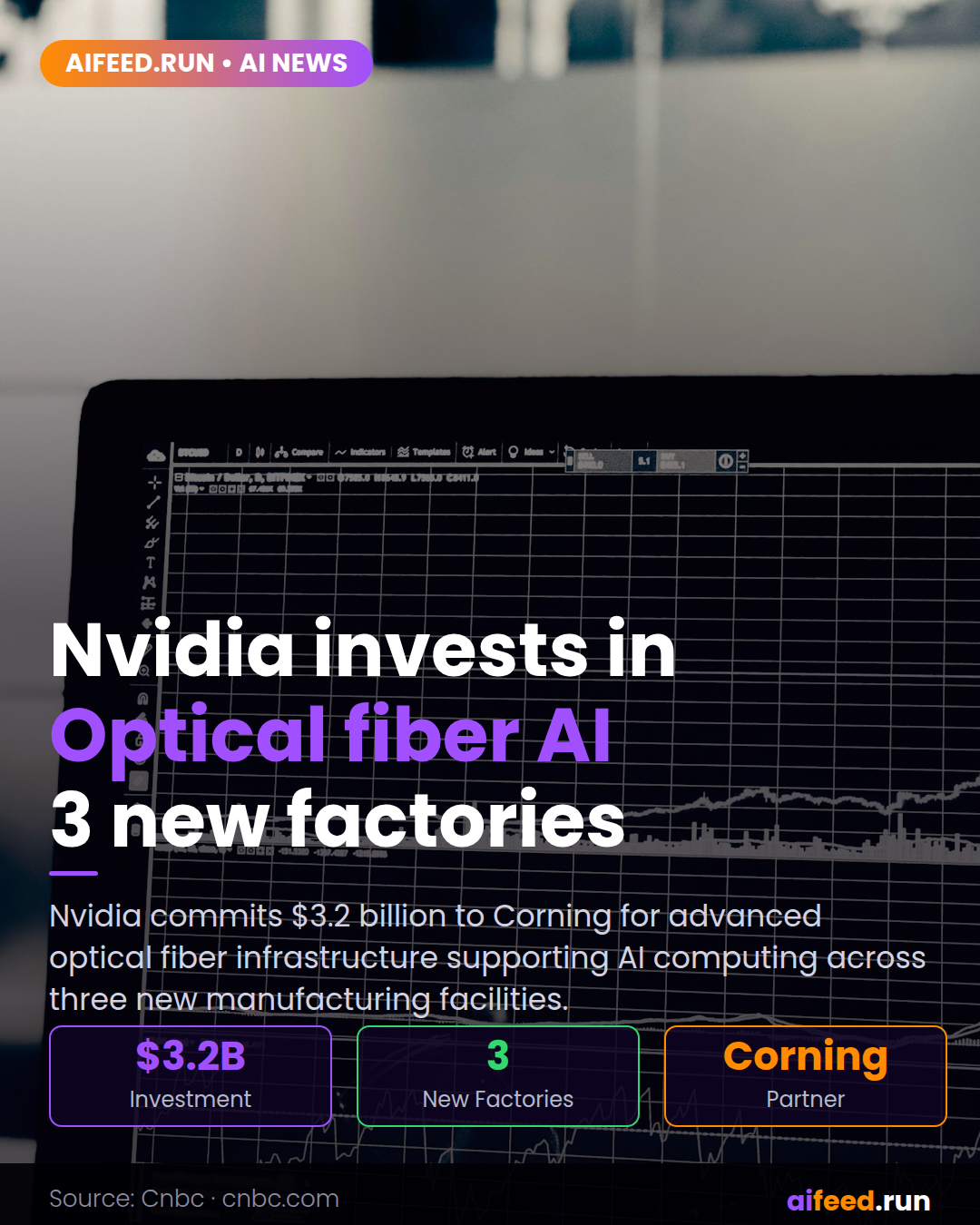
This massive deal includes three new factories dedicated to producing optical fiber specifically designed for AI applications. The announcement underscores a critical reality: the computational demand
This massive deal includes three new factories dedicated to producing optical fiber specifically designed for AI applications. The announcement underscores a critical reality: the computational demands of modern AI systems aren't just about processors—they require equally sophisticated connectivity infrastructure. Nvidia's willingness to invest this scale of capital into Corning demonstrates that optical fiber has become a strategic bottleneck in scaling AI infrastructure globally.
Optical fiber serves as the backbone for data transmission between servers and data centers, operating at speeds and volumes that traditional copper infrastructure simply cannot match. As AI models grow exponentially larger and require interconnected clusters of GPUs, the data transmission capacity becomes just as important as the compute power itself. Corning's expertise in glass science and fiber optics positions them uniquely to support the next generation of AI infrastructure demands.
For investors and industry strategists, this partnership reveals where the real value creation is happening in the AI economy. While attention often focuses on GPU manufacturers and AI software companies, the infrastructure enablers—companies like Corning—are becoming indispensable. This investment also reflects vertical integration strategies where hardware companies are securing supply chains for critical components.
The broader implications for the AI industry are substantial. If optical fiber capacity becomes a limiting factor in deploying AI systems at scale, then companies controlling that supply chain gain tremendous leverage. The three new factories represent confidence that global demand for AI infrastructure will continue accelerating and that optical fiber will remain central to supporting that growth.
Looking ahead, we should expect more major tech companies to make similar infrastructure plays. The winners in the AI era won't just build better models—they'll control the physical infrastructure enabling those models to communicate and operate at scale.
The real innovation in AI infrastructure isn't always visible on a screen—it's in the fiber carrying the signals.
#AI #Nvidia #Infrastructure #TechInvestment #OpticalFiber #SupplyChain #ArtificialIntelligence #DataCenter
Source: CNBC
More AI news
- Cloudflare stock sinks 18% after earnings as company cuts 1,100 employees due to AI changes
- Google's AI search summaries will now quote Reddit
- Akamai stock soars 20% on earnings, $1.8 billion AI infrastructure deal
- Claude Code is getting higher usage limits, doubled for most users
- Agents can now create Cloudflare accounts, buy domains, and deploy
- Samsung crosses $1 trillion valuation as AI frenzy drives historic rally, lifting shares over 15%
 `;
}
function imgFallback(el) {
if (!el.dataset.fb) { el.dataset.fb = '1'; el.removeAttribute('srcset'); el.src = el.dataset.full; }
else { el.style.visibility = 'hidden'; }
}
function formatDate(iso) {
if (!iso) return '';
return new Date(iso).toLocaleDateString('en-US', { month: 'long', day: 'numeric', year: 'numeric' });
}
function handleSubscribe(e) {
e.preventDefault();
const email = document.getElementById('inline-email').value;
e.target.reset();
goSubscribe(email, 'article');
}
// One step: the email typed on the page goes straight to Beehiiv's confirm page (no second form).
function goSubscribe(email, source) {
window.__subSource = source;
const url = 'https://magic.beehiiv.com/v1/eb0b9508-1ffd-4fb1-a63c-e762fa86569c?email=' + encodeURIComponent(email)
+ '&utm_source=aifeed.run&utm_medium=website&utm_campaign=' + encodeURIComponent(source || 'site');
// Same tab (no popup: in-app browsers like Instagram's prompt on new windows); Beehiiv sends the visitor to our thanks page after the one tap.
window.location.href = url + '&redirect_to=' + encodeURIComponent('https://aifeed.run/subscribe/thanks/'); return;
try { w.opener = null; } catch (err) {}
document.getElementById('sub-email-field').value = email;
document.getElementById('sub-form-state').style.display = 'none';
document.getElementById('sub-success-state').style.display = 'block';
document.getElementById('sub-overlay').style.display = 'flex';
document.body.style.overflow = 'hidden';
}
function openSubOverlay(email) {
document.getElementById('sub-email-field').value = email;
document.getElementById('sub-form-state').style.display = 'block';
document.getElementById('sub-success-state').style.display = 'none';
document.getElementById('sub-btn').textContent = 'Subscribe — It\'s Free →';
document.getElementById('sub-btn').disabled = false;
document.getElementById('sub-overlay').style.display = 'flex';
document.body.style.overflow = 'hidden';
}
const BEEHIIV_SUBSCRIBE_URL = 'https://magic.beehiiv.com/v1/eb0b9508-1ffd-4fb1-a63c-e762fa86569c'; // Beehiiv public Magic Link for AIFeed.run (pub_eb0b9508-…), no API key
async function submitSubscribe(e) {
e.preventDefault();
const email = document.getElementById('sub-email-field').value;
const btn = document.getElementById('sub-btn');
btn.textContent = 'Opening signup...';
btn.disabled = true;
// Opens Beehiiv's one-click confirm page for this email ("You'll be subscribed with …"). No secret client-side.
const bhUrl = BEEHIIV_SUBSCRIBE_URL + '?email=' + encodeURIComponent(email)
+ '&utm_source=aifeed.run&utm_medium=website&utm_campaign=' + encodeURIComponent(window.__subSource || 'site');
// Same tab (no popup: in-app browsers like Instagram's prompt on new windows); Beehiiv sends the visitor to our thanks page after the one tap.
window.location.href = bhUrl + '&redirect_to=' + encodeURIComponent('https://aifeed.run/subscribe/thanks/'); return;
try { w.opener = null; } catch (err) {}
document.getElementById('sub-form-state').style.display = 'none';
document.getElementById('sub-success-state').style.display = 'block';
}
function closeSubOverlay(e) {
if (e && e.target && e.target.id !== 'sub-overlay' && e.target.id !== 'sub-close-btn') return;
document.getElementById('sub-overlay').style.display = 'none';
document.body.style.overflow = '';
}
function copyLink() {
navigator.clipboard.writeText(window.location.href).then(() => {
const t = document.getElementById('toast');
t.textContent = '🔗 Link copied!';
t.classList.add('show');
setTimeout(() => t.classList.remove('show'), 2500);
});
}
function showToast() {
const t = document.getElementById('toast');
t.textContent = '🎉 You\'re subscribed! Welcome to the feed.';
t.classList.add('show');
setTimeout(() => t.classList.remove('show'), 3500);
}
function getDemoPosts() {
return [
{
id: 'demo-1', slug: 'apple-building-ai-glasses-beat-meta',
headline: 'Apple Is Building AI Glasses To Beat Meta',
summary: 'No screen. Just AI, cameras, and Siri. 4 designs. Premium acetate. Ships 2027.',
body: '