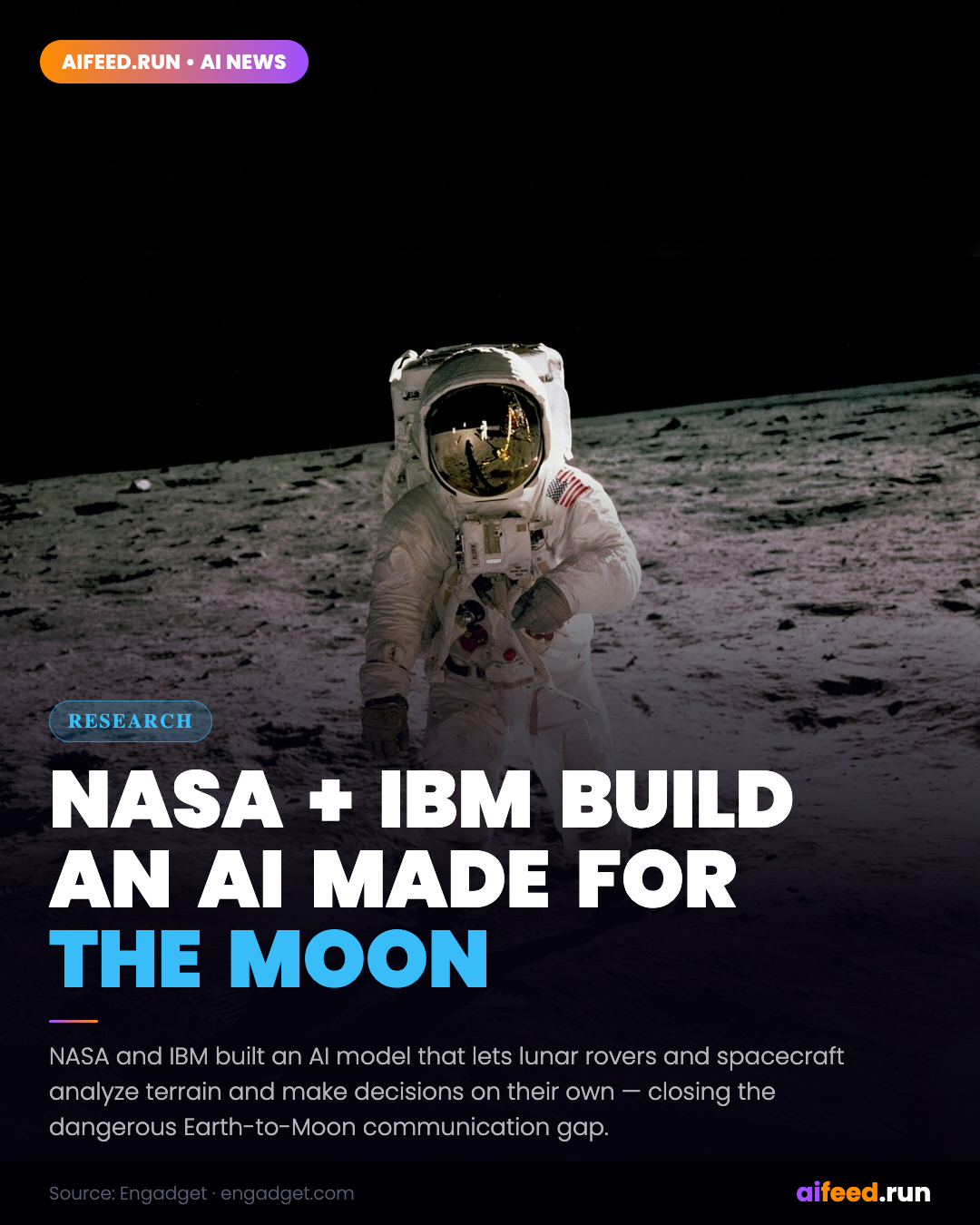
NASA and IBM built an AI model that lets lunar rovers and spacecraft analyze terrain and make decisions on their own — closing the dangerous Earth-to-Moon communication gap.
NASA and IBM have developed a groundbreaking AI model built specifically for lunar exploration — a milestone in the collaboration between space technology and artificial intelligence.
The model tackles one of the toughest challenges in lunar missions: the communication delay between Earth and the Moon. Instead of waiting on ground teams for every instruction, rovers and spacecraft can now analyze lunar terrain, identify obstacles, and optimize operations in real time.
Strategically, it marks a shift in how agencies approach space. Rather than relying solely on pre-programmed missions, they're leveraging AI to create adaptive, intelligent systems that reduce risk and open new possibilities for exploration and discovery on the lunar surface.
The broader industry is taking notice. When institutions like NASA adopt and champion AI, it validates the technology and accelerates enterprise adoption — proof that AI is becoming essential infrastructure for humanity's most ambitious endeavors.
This NASA–IBM collaboration is only the first step. As models grow more capable of handling extreme environments, expect similar applications across deep space, planetary science, and interplanetary missions.
`;
}
// ─── HELPERS ─────────────────────────────────────────────────────────
function escHtml(s) { return String(s == null ? '' : s).replace(/&/g,'&').replace(/"/g,'"').replace(//g,'>'); }
function storyImg(p, cls, sizes) {
const url = p.imageUrl || '';
if (!url) return ``;
const m = /^(?:https:\/\/aifeed\.run)?\/?images\/([^\/?#]+)\.(?:png|jpe?g|webp)$/i.exec(url);
const alt = escHtml(p.headline || 'AI news story');
if (!m) return ``;
const t = '/thumbs/' + m[1];
return ``;
}
function imgFallback(el) {
if (!el.dataset.fb) { el.dataset.fb = '1'; el.removeAttribute('srcset'); el.src = el.dataset.full; }
else { el.style.visibility = 'hidden'; }
}
function formatDate(iso) {
if (!iso) return '';
return new Date(iso).toLocaleDateString('en-US', { month: 'long', day: 'numeric', year: 'numeric' });
}
function handleSubscribe(e) {
e.preventDefault();
const email = document.getElementById('inline-email').value;
e.target.reset();
goSubscribe(email, 'article');
}
// One step: the email typed on the page goes straight to Beehiiv's confirm page (no second form).
function goSubscribe(email, source) {
window.__subSource = source;
const url = 'https://magic.beehiiv.com/v1/eb0b9508-1ffd-4fb1-a63c-e762fa86569c?email=' + encodeURIComponent(email)
+ '&utm_source=aifeed.run&utm_medium=website&utm_campaign=' + encodeURIComponent(source || 'site');
// Same tab (no popup: in-app browsers like Instagram's prompt on new windows); Beehiiv sends the visitor to our thanks page after the one tap.
window.location.href = url + '&redirect_to=' + encodeURIComponent('https://aifeed.run/subscribe/thanks/'); return;
try { w.opener = null; } catch (err) {}
document.getElementById('sub-email-field').value = email;
document.getElementById('sub-form-state').style.display = 'none';
document.getElementById('sub-success-state').style.display = 'block';
document.getElementById('sub-overlay').style.display = 'flex';
document.body.style.overflow = 'hidden';
}
function openSubOverlay(email) {
document.getElementById('sub-email-field').value = email;
document.getElementById('sub-form-state').style.display = 'block';
document.getElementById('sub-success-state').style.display = 'none';
document.getElementById('sub-btn').textContent = 'Subscribe — It\'s Free →';
document.getElementById('sub-btn').disabled = false;
document.getElementById('sub-overlay').style.display = 'flex';
document.body.style.overflow = 'hidden';
}
const BEEHIIV_SUBSCRIBE_URL = 'https://magic.beehiiv.com/v1/eb0b9508-1ffd-4fb1-a63c-e762fa86569c'; // Beehiiv public Magic Link for AIFeed.run (pub_eb0b9508-…), no API key
async function submitSubscribe(e) {
e.preventDefault();
const email = document.getElementById('sub-email-field').value;
const btn = document.getElementById('sub-btn');
btn.textContent = 'Opening signup...';
btn.disabled = true;
// Opens Beehiiv's one-click confirm page for this email ("You'll be subscribed with …"). No secret client-side.
const bhUrl = BEEHIIV_SUBSCRIBE_URL + '?email=' + encodeURIComponent(email)
+ '&utm_source=aifeed.run&utm_medium=website&utm_campaign=' + encodeURIComponent(window.__subSource || 'site');
// Same tab (no popup: in-app browsers like Instagram's prompt on new windows); Beehiiv sends the visitor to our thanks page after the one tap.
window.location.href = bhUrl + '&redirect_to=' + encodeURIComponent('https://aifeed.run/subscribe/thanks/'); return;
try { w.opener = null; } catch (err) {}
document.getElementById('sub-form-state').style.display = 'none';
document.getElementById('sub-success-state').style.display = 'block';
}
function closeSubOverlay(e) {
if (e && e.target && e.target.id !== 'sub-overlay' && e.target.id !== 'sub-close-btn') return;
document.getElementById('sub-overlay').style.display = 'none';
document.body.style.overflow = '';
}
function copyLink() {
navigator.clipboard.writeText(window.location.href).then(() => {
const t = document.getElementById('toast');
t.textContent = '🔗 Link copied!';
t.classList.add('show');
setTimeout(() => t.classList.remove('show'), 2500);
});
}
function showToast() {
const t = document.getElementById('toast');
t.textContent = '🎉 You\'re subscribed! Welcome to the feed.';
t.classList.add('show');
setTimeout(() => t.classList.remove('show'), 3500);
}
function getDemoPosts() {
return [
{
id: 'demo-1', slug: 'apple-building-ai-glasses-beat-meta',
headline: 'Apple Is Building AI Glasses To Beat Meta',
summary: 'No screen. Just AI, cameras, and Siri. 4 designs. Premium acetate. Ships 2027.',
body: '
Apple is reportedly developing AI-powered smart glasses designed to compete directly with Meta\'s Ray-Ban AI glasses — and the early details are compelling.
Unlike the Vision Pro, these will have no display at all. Instead, they\'ll rely entirely on AI processing: cameras, Siri integration, and ambient computing. Four frame styles are planned, with premium acetate construction targeting a fashion-forward audience.
The $499 starting price positions them as a premium-but-accessible device — significantly cheaper than Vision Pro but pricier than Meta\'s Ray-Bans. A 2027 launch window gives Apple time to refine the AI stack that will power them.
This move signals Apple\'s belief that ambient AI wearables — not VR headsets — will be the mainstream computing interface of the next decade.
',
category: 'Products', hashtags: ['apple', 'AIglasses', 'meta', 'wearables'],
publishedAt: new Date().toISOString(), imageUrl: ''
},
{
id: 'demo-2', slug: 'google-gemma-4-free-ai-lives-on-phone',
headline: 'Google Gemma 4: Free AI That Lives On Your Phone',
summary: 'Runs locally. Chats never saved. No cloud. Free on iOS and Android right now.',
body: '
Google has released Gemma 4, its most capable on-device AI model yet — and it\'s free on both iOS and Android.
The key differentiator: everything runs locally. Your conversations never leave your device, never hit a server, and are never stored. For privacy-conscious users, this is a significant shift.
Performance gains are substantial. Gemma 4 is reportedly 4x faster than its predecessor and uses 60% less battery — critical specs for a model running continuously on mobile hardware. Google claims it reaches 140 million Android devices immediately at launch.
This puts real competitive pressure on Apple Intelligence and signals that on-device AI is no longer a compromise — it\'s becoming the preferred architecture for consumer AI.
',
category: 'Models', hashtags: ['google', 'gemma', 'mobileAI', 'privacy'],
publishedAt: new Date(Date.now() - 86400000).toISOString(), imageUrl: ''
},
{
id: 'demo-3', slug: 'agi-will-hit-10-revolutions-one-decade',
headline: 'AGI Will Hit Like 10 Revolutions In One Decade',
summary: 'Leading researchers now agree: AGI arrival will compress a century of change into ten years.',
body: '
The consensus among leading AI researchers is shifting from "if" to "when" — and increasingly, the answer is "soon."
A growing number of labs now believe AGI will compress decades of civilizational change into a single decade. Not one industrial revolution, but ten — simultaneously — across medicine, energy, materials science, software, and beyond.
This framing is gaining traction not as hyperbole but as a calibrated forecast from people with direct access to the most capable systems being built today.
What changes first: knowledge work. Then physical labor. Then scientific research itself. The sequencing matters less than the speed.
 `;
}
function imgFallback(el) {
if (!el.dataset.fb) { el.dataset.fb = '1'; el.removeAttribute('srcset'); el.src = el.dataset.full; }
else { el.style.visibility = 'hidden'; }
}
function formatDate(iso) {
if (!iso) return '';
return new Date(iso).toLocaleDateString('en-US', { month: 'long', day: 'numeric', year: 'numeric' });
}
function handleSubscribe(e) {
e.preventDefault();
const email = document.getElementById('inline-email').value;
e.target.reset();
goSubscribe(email, 'article');
}
// One step: the email typed on the page goes straight to Beehiiv's confirm page (no second form).
function goSubscribe(email, source) {
window.__subSource = source;
const url = 'https://magic.beehiiv.com/v1/eb0b9508-1ffd-4fb1-a63c-e762fa86569c?email=' + encodeURIComponent(email)
+ '&utm_source=aifeed.run&utm_medium=website&utm_campaign=' + encodeURIComponent(source || 'site');
// Same tab (no popup: in-app browsers like Instagram's prompt on new windows); Beehiiv sends the visitor to our thanks page after the one tap.
window.location.href = url + '&redirect_to=' + encodeURIComponent('https://aifeed.run/subscribe/thanks/'); return;
try { w.opener = null; } catch (err) {}
document.getElementById('sub-email-field').value = email;
document.getElementById('sub-form-state').style.display = 'none';
document.getElementById('sub-success-state').style.display = 'block';
document.getElementById('sub-overlay').style.display = 'flex';
document.body.style.overflow = 'hidden';
}
function openSubOverlay(email) {
document.getElementById('sub-email-field').value = email;
document.getElementById('sub-form-state').style.display = 'block';
document.getElementById('sub-success-state').style.display = 'none';
document.getElementById('sub-btn').textContent = 'Subscribe — It\'s Free →';
document.getElementById('sub-btn').disabled = false;
document.getElementById('sub-overlay').style.display = 'flex';
document.body.style.overflow = 'hidden';
}
const BEEHIIV_SUBSCRIBE_URL = 'https://magic.beehiiv.com/v1/eb0b9508-1ffd-4fb1-a63c-e762fa86569c'; // Beehiiv public Magic Link for AIFeed.run (pub_eb0b9508-…), no API key
async function submitSubscribe(e) {
e.preventDefault();
const email = document.getElementById('sub-email-field').value;
const btn = document.getElementById('sub-btn');
btn.textContent = 'Opening signup...';
btn.disabled = true;
// Opens Beehiiv's one-click confirm page for this email ("You'll be subscribed with …"). No secret client-side.
const bhUrl = BEEHIIV_SUBSCRIBE_URL + '?email=' + encodeURIComponent(email)
+ '&utm_source=aifeed.run&utm_medium=website&utm_campaign=' + encodeURIComponent(window.__subSource || 'site');
// Same tab (no popup: in-app browsers like Instagram's prompt on new windows); Beehiiv sends the visitor to our thanks page after the one tap.
window.location.href = bhUrl + '&redirect_to=' + encodeURIComponent('https://aifeed.run/subscribe/thanks/'); return;
try { w.opener = null; } catch (err) {}
document.getElementById('sub-form-state').style.display = 'none';
document.getElementById('sub-success-state').style.display = 'block';
}
function closeSubOverlay(e) {
if (e && e.target && e.target.id !== 'sub-overlay' && e.target.id !== 'sub-close-btn') return;
document.getElementById('sub-overlay').style.display = 'none';
document.body.style.overflow = '';
}
function copyLink() {
navigator.clipboard.writeText(window.location.href).then(() => {
const t = document.getElementById('toast');
t.textContent = '🔗 Link copied!';
t.classList.add('show');
setTimeout(() => t.classList.remove('show'), 2500);
});
}
function showToast() {
const t = document.getElementById('toast');
t.textContent = '🎉 You\'re subscribed! Welcome to the feed.';
t.classList.add('show');
setTimeout(() => t.classList.remove('show'), 3500);
}
function getDemoPosts() {
return [
{
id: 'demo-1', slug: 'apple-building-ai-glasses-beat-meta',
headline: 'Apple Is Building AI Glasses To Beat Meta',
summary: 'No screen. Just AI, cameras, and Siri. 4 designs. Premium acetate. Ships 2027.',
body: '