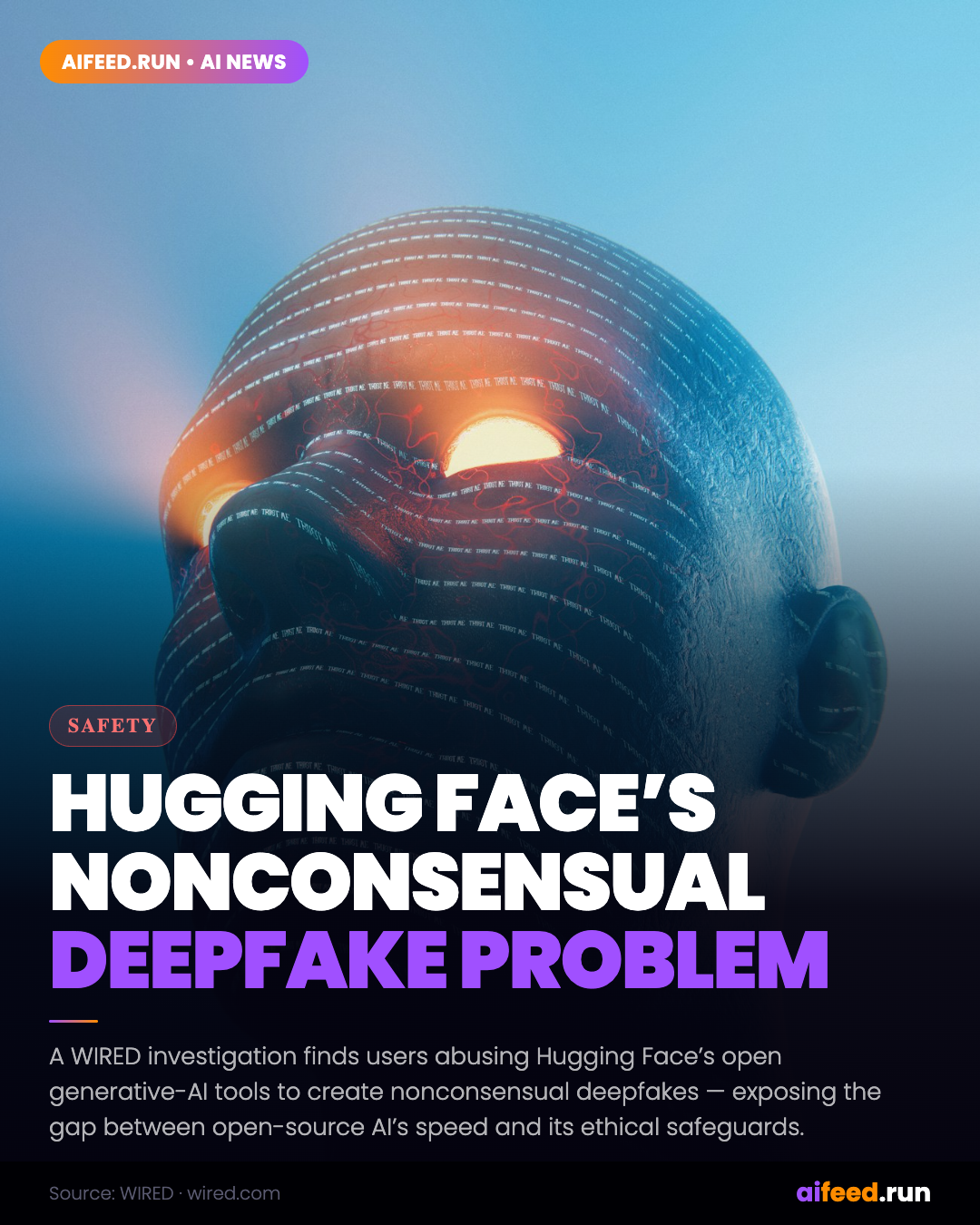
Hugging Face Has a Nonconsensual Deepfakes Problem
· Safety
A WIRED investigation finds users abusing Hugging Face's open generative-AI tools to create nonconsensual deepfakes — exposing the gap between open-source AI's speed and its ethical safeguards.
Open-source AI platforms are struggling to prevent nonconsensual deepfake content—and the problem is more pervasive than most realize.
Hugging Face, a leading hub for machine learning models and datasets used by researchers and developers worldwide, has become an inadvertent facilitator of image-based abuse. Users are leveraging the platform's generative AI tools to create nonconsensual explicit deepfakes, highlighting a critical gap between innovation velocity and ethical safeguards. This isn't an isolated incident—it reflects systemic vulnerabilities across the broader AI ecosystem where accessibility and open-source principles, while democratizing technology, also democratize potential harm.
The business and technology context matters here. Hugging Face's model is built on transparency and community contribution, which has accelerated AI development and made cutting-edge tools accessible to millions. However, this openness creates inherent moderation challenges that proprietary platforms don't face at the same scale. The platform now finds itself at a crossroads between maintaining its open ethos and implementing the restrictive measures necessary to prevent abuse.
Strategically, this incident signals a watershed moment for the AI industry. Companies building foundational AI tools must now factor in abuse prevention as a core business requirement, not an afterthought. Investors, partners, and users will increasingly scrutinize governance frameworks alongside technological capability.
The broader AI industry implication is profound: without proactive ethical infrastructure, we risk a regulatory backlash that could stifle legitimate innovation. The EU's AI Act, state-level regulations, and industry pressure are all converging to demand better guardrails. Companies that get ahead of this will win trust; those that don't will face both reputational and legal consequences.
Moving forward, the question isn't whether open-source AI platforms will implement stricter content policies—they must. The real challenge is doing so without abandoning the principles that made them valuable in the first place.
The future of responsible AI depends on solving this tension now.
`;
}
// ─── HELPERS ─────────────────────────────────────────────────────────
function escHtml(s) { return String(s == null ? '' : s).replace(/&/g,'&').replace(/"/g,'"').replace(//g,'>'); }
function storyImg(p, cls, sizes) {
const url = p.imageUrl || '';
if (!url) return ``;
const m = /^(?:https:\/\/aifeed\.run)?\/?images\/([^\/?#]+)\.(?:png|jpe?g|webp)$/i.exec(url);
const alt = escHtml(p.headline || 'AI news story');
if (!m) return ``;
const t = '/thumbs/' + m[1];
return ``;
}
function imgFallback(el) {
if (!el.dataset.fb) { el.dataset.fb = '1'; el.removeAttribute('srcset'); el.src = el.dataset.full; }
else { el.style.visibility = 'hidden'; }
}
function formatDate(iso) {
if (!iso) return '';
return new Date(iso).toLocaleDateString('en-US', { month: 'long', day: 'numeric', year: 'numeric' });
}
function handleSubscribe(e) {
e.preventDefault();
const email = document.getElementById('inline-email').value;
e.target.reset();
goSubscribe(email, 'article');
}
// One step: the email typed on the page goes straight to Beehiiv's confirm page (no second form).
function goSubscribe(email, source) {
window.__subSource = source;
const url = 'https://magic.beehiiv.com/v1/eb0b9508-1ffd-4fb1-a63c-e762fa86569c?email=' + encodeURIComponent(email)
+ '&utm_source=aifeed.run&utm_medium=website&utm_campaign=' + encodeURIComponent(source || 'site');
// Same tab (no popup: in-app browsers like Instagram's prompt on new windows); Beehiiv sends the visitor to our thanks page after the one tap.
window.location.href = url + '&redirect_to=' + encodeURIComponent('https://aifeed.run/subscribe/thanks/'); return;
try { w.opener = null; } catch (err) {}
document.getElementById('sub-email-field').value = email;
document.getElementById('sub-form-state').style.display = 'none';
document.getElementById('sub-success-state').style.display = 'block';
document.getElementById('sub-overlay').style.display = 'flex';
document.body.style.overflow = 'hidden';
}
function openSubOverlay(email) {
document.getElementById('sub-email-field').value = email;
document.getElementById('sub-form-state').style.display = 'block';
document.getElementById('sub-success-state').style.display = 'none';
document.getElementById('sub-btn').textContent = 'Subscribe — It\'s Free →';
document.getElementById('sub-btn').disabled = false;
document.getElementById('sub-overlay').style.display = 'flex';
document.body.style.overflow = 'hidden';
}
const BEEHIIV_SUBSCRIBE_URL = 'https://magic.beehiiv.com/v1/eb0b9508-1ffd-4fb1-a63c-e762fa86569c'; // Beehiiv public Magic Link for AIFeed.run (pub_eb0b9508-…), no API key
async function submitSubscribe(e) {
e.preventDefault();
const email = document.getElementById('sub-email-field').value;
const btn = document.getElementById('sub-btn');
btn.textContent = 'Opening signup...';
btn.disabled = true;
// Opens Beehiiv's one-click confirm page for this email ("You'll be subscribed with …"). No secret client-side.
const bhUrl = BEEHIIV_SUBSCRIBE_URL + '?email=' + encodeURIComponent(email)
+ '&utm_source=aifeed.run&utm_medium=website&utm_campaign=' + encodeURIComponent(window.__subSource || 'site');
// Same tab (no popup: in-app browsers like Instagram's prompt on new windows); Beehiiv sends the visitor to our thanks page after the one tap.
window.location.href = bhUrl + '&redirect_to=' + encodeURIComponent('https://aifeed.run/subscribe/thanks/'); return;
try { w.opener = null; } catch (err) {}
document.getElementById('sub-form-state').style.display = 'none';
document.getElementById('sub-success-state').style.display = 'block';
}
function closeSubOverlay(e) {
if (e && e.target && e.target.id !== 'sub-overlay' && e.target.id !== 'sub-close-btn') return;
document.getElementById('sub-overlay').style.display = 'none';
document.body.style.overflow = '';
}
function copyLink() {
navigator.clipboard.writeText(window.location.href).then(() => {
const t = document.getElementById('toast');
t.textContent = '🔗 Link copied!';
t.classList.add('show');
setTimeout(() => t.classList.remove('show'), 2500);
});
}
function showToast() {
const t = document.getElementById('toast');
t.textContent = '🎉 You\'re subscribed! Welcome to the feed.';
t.classList.add('show');
setTimeout(() => t.classList.remove('show'), 3500);
}
function getDemoPosts() {
return [
{
id: 'demo-1', slug: 'apple-building-ai-glasses-beat-meta',
headline: 'Apple Is Building AI Glasses To Beat Meta',
summary: 'No screen. Just AI, cameras, and Siri. 4 designs. Premium acetate. Ships 2027.',
body: '
Apple is reportedly developing AI-powered smart glasses designed to compete directly with Meta\'s Ray-Ban AI glasses — and the early details are compelling.
Unlike the Vision Pro, these will have no display at all. Instead, they\'ll rely entirely on AI processing: cameras, Siri integration, and ambient computing. Four frame styles are planned, with premium acetate construction targeting a fashion-forward audience.
The $499 starting price positions them as a premium-but-accessible device — significantly cheaper than Vision Pro but pricier than Meta\'s Ray-Bans. A 2027 launch window gives Apple time to refine the AI stack that will power them.
This move signals Apple\'s belief that ambient AI wearables — not VR headsets — will be the mainstream computing interface of the next decade.
',
category: 'Products', hashtags: ['apple', 'AIglasses', 'meta', 'wearables'],
publishedAt: new Date().toISOString(), imageUrl: ''
},
{
id: 'demo-2', slug: 'google-gemma-4-free-ai-lives-on-phone',
headline: 'Google Gemma 4: Free AI That Lives On Your Phone',
summary: 'Runs locally. Chats never saved. No cloud. Free on iOS and Android right now.',
body: '
Google has released Gemma 4, its most capable on-device AI model yet — and it\'s free on both iOS and Android.
The key differentiator: everything runs locally. Your conversations never leave your device, never hit a server, and are never stored. For privacy-conscious users, this is a significant shift.
Performance gains are substantial. Gemma 4 is reportedly 4x faster than its predecessor and uses 60% less battery — critical specs for a model running continuously on mobile hardware. Google claims it reaches 140 million Android devices immediately at launch.
This puts real competitive pressure on Apple Intelligence and signals that on-device AI is no longer a compromise — it\'s becoming the preferred architecture for consumer AI.
',
category: 'Models', hashtags: ['google', 'gemma', 'mobileAI', 'privacy'],
publishedAt: new Date(Date.now() - 86400000).toISOString(), imageUrl: ''
},
{
id: 'demo-3', slug: 'agi-will-hit-10-revolutions-one-decade',
headline: 'AGI Will Hit Like 10 Revolutions In One Decade',
summary: 'Leading researchers now agree: AGI arrival will compress a century of change into ten years.',
body: '
The consensus among leading AI researchers is shifting from "if" to "when" — and increasingly, the answer is "soon."
A growing number of labs now believe AGI will compress decades of civilizational change into a single decade. Not one industrial revolution, but ten — simultaneously — across medicine, energy, materials science, software, and beyond.
This framing is gaining traction not as hyperbole but as a calibrated forecast from people with direct access to the most capable systems being built today.
What changes first: knowledge work. Then physical labor. Then scientific research itself. The sequencing matters less than the speed.
 `;
}
function imgFallback(el) {
if (!el.dataset.fb) { el.dataset.fb = '1'; el.removeAttribute('srcset'); el.src = el.dataset.full; }
else { el.style.visibility = 'hidden'; }
}
function formatDate(iso) {
if (!iso) return '';
return new Date(iso).toLocaleDateString('en-US', { month: 'long', day: 'numeric', year: 'numeric' });
}
function handleSubscribe(e) {
e.preventDefault();
const email = document.getElementById('inline-email').value;
e.target.reset();
goSubscribe(email, 'article');
}
// One step: the email typed on the page goes straight to Beehiiv's confirm page (no second form).
function goSubscribe(email, source) {
window.__subSource = source;
const url = 'https://magic.beehiiv.com/v1/eb0b9508-1ffd-4fb1-a63c-e762fa86569c?email=' + encodeURIComponent(email)
+ '&utm_source=aifeed.run&utm_medium=website&utm_campaign=' + encodeURIComponent(source || 'site');
// Same tab (no popup: in-app browsers like Instagram's prompt on new windows); Beehiiv sends the visitor to our thanks page after the one tap.
window.location.href = url + '&redirect_to=' + encodeURIComponent('https://aifeed.run/subscribe/thanks/'); return;
try { w.opener = null; } catch (err) {}
document.getElementById('sub-email-field').value = email;
document.getElementById('sub-form-state').style.display = 'none';
document.getElementById('sub-success-state').style.display = 'block';
document.getElementById('sub-overlay').style.display = 'flex';
document.body.style.overflow = 'hidden';
}
function openSubOverlay(email) {
document.getElementById('sub-email-field').value = email;
document.getElementById('sub-form-state').style.display = 'block';
document.getElementById('sub-success-state').style.display = 'none';
document.getElementById('sub-btn').textContent = 'Subscribe — It\'s Free →';
document.getElementById('sub-btn').disabled = false;
document.getElementById('sub-overlay').style.display = 'flex';
document.body.style.overflow = 'hidden';
}
const BEEHIIV_SUBSCRIBE_URL = 'https://magic.beehiiv.com/v1/eb0b9508-1ffd-4fb1-a63c-e762fa86569c'; // Beehiiv public Magic Link for AIFeed.run (pub_eb0b9508-…), no API key
async function submitSubscribe(e) {
e.preventDefault();
const email = document.getElementById('sub-email-field').value;
const btn = document.getElementById('sub-btn');
btn.textContent = 'Opening signup...';
btn.disabled = true;
// Opens Beehiiv's one-click confirm page for this email ("You'll be subscribed with …"). No secret client-side.
const bhUrl = BEEHIIV_SUBSCRIBE_URL + '?email=' + encodeURIComponent(email)
+ '&utm_source=aifeed.run&utm_medium=website&utm_campaign=' + encodeURIComponent(window.__subSource || 'site');
// Same tab (no popup: in-app browsers like Instagram's prompt on new windows); Beehiiv sends the visitor to our thanks page after the one tap.
window.location.href = bhUrl + '&redirect_to=' + encodeURIComponent('https://aifeed.run/subscribe/thanks/'); return;
try { w.opener = null; } catch (err) {}
document.getElementById('sub-form-state').style.display = 'none';
document.getElementById('sub-success-state').style.display = 'block';
}
function closeSubOverlay(e) {
if (e && e.target && e.target.id !== 'sub-overlay' && e.target.id !== 'sub-close-btn') return;
document.getElementById('sub-overlay').style.display = 'none';
document.body.style.overflow = '';
}
function copyLink() {
navigator.clipboard.writeText(window.location.href).then(() => {
const t = document.getElementById('toast');
t.textContent = '🔗 Link copied!';
t.classList.add('show');
setTimeout(() => t.classList.remove('show'), 2500);
});
}
function showToast() {
const t = document.getElementById('toast');
t.textContent = '🎉 You\'re subscribed! Welcome to the feed.';
t.classList.add('show');
setTimeout(() => t.classList.remove('show'), 3500);
}
function getDemoPosts() {
return [
{
id: 'demo-1', slug: 'apple-building-ai-glasses-beat-meta',
headline: 'Apple Is Building AI Glasses To Beat Meta',
summary: 'No screen. Just AI, cameras, and Siri. 4 designs. Premium acetate. Ships 2027.',
body: '