Erling Haaland Is Everywhere at the World Cup — Most of It Is AI
· Safety
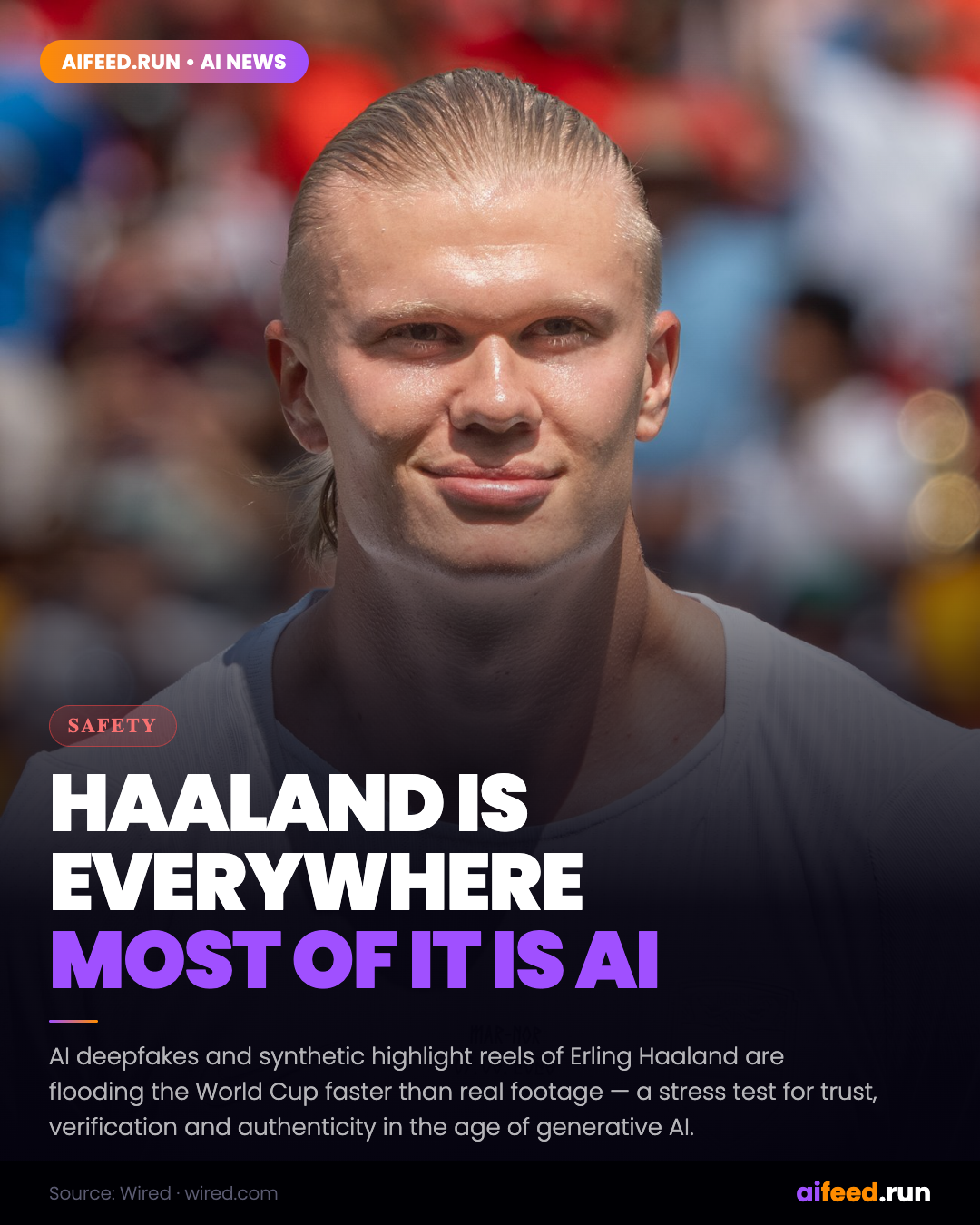
AI deepfakes and synthetic highlight reels of Erling Haaland are spreading across the World Cup faster than real footage — a stress test for trust and content authenticity in the age of generative AI.
The line between authentic sports content and AI-generated deepfakes just got dangerously blurry. Erling Haaland's digital presence at the World Cup has exploded across social media—except most of it never actually happened. Synthetic videos, AI-created highlight reels, and deepfake moments are spreading faster than legitimate coverage, raising critical questions about authenticity, trust, and content verification in the age of advanced artificial intelligence.
This phenomenon reveals a fundamental shift in how digital media operates. As generative AI tools become increasingly accessible and sophisticated, the barrier to creating convincing synthetic content has collapsed. What once required Hollywood-level resources and expertise now takes minutes with the right algorithms. Sports, with its massive audience and emotional investment, represents the perfect storm for synthetic content proliferation.
The strategic implications for media organizations, sports leagues, and tech platforms are profound. We're witnessing a test case for how institutions will govern AI-generated content at scale. Authentication mechanisms, digital watermarks, and fact-checking infrastructure are becoming competitive advantages—not nice-to-haves. Organizations must decide now how to maintain credibility in an era where seeing is no longer believing.
Beyond sports, this signals a broader reckoning across industries. If deepfakes can infiltrate World Cup coverage, they can infiltrate any sector: finance, politics, healthcare. The AI industry faces mounting pressure to develop responsibility frameworks faster than the technology itself evolves. Technical solutions like detection tools and blockchain verification are emerging, but they're racing against sophistication.
The next phase won't just be about detecting AI-generated content—it'll be about establishing new standards for digital authenticity. Organizations that invest in verification infrastructure and transparent sourcing will build consumer trust. Those that don't risk becoming sources of misinformation, intentionally or otherwise.
In a world where AI can make anyone appear anywhere, authentic content becomes our most valuable commodity.
Source: WIRED
More AI news
- Meta Jumps Into the AI Coding Market to Chase Anthropic and OpenAI
- U.S. Lawmakers Probe Growing Use of Chinese AI Models in American Companies
- Meta Now Lets Anyone Use Your Instagram Photos in AI Images — Unless You Opt Out
- Takeda Signs $600 Million AI Drug-Discovery Deal With Insilico Medicine
- OpenAI Floats Giving the Trump Administration a 5% Cut of the AI Boom
- Microsoft Commits $2.5 Billion and 6,000 Employees to an AI Implementation Unit
 `;
}
function imgFallback(el) {
if (!el.dataset.fb) { el.dataset.fb = '1'; el.removeAttribute('srcset'); el.src = el.dataset.full; }
else { el.style.visibility = 'hidden'; }
}
function formatDate(iso) {
if (!iso) return '';
return new Date(iso).toLocaleDateString('en-US', { month: 'long', day: 'numeric', year: 'numeric' });
}
function handleSubscribe(e) {
e.preventDefault();
const email = document.getElementById('inline-email').value;
e.target.reset();
goSubscribe(email, 'article');
}
// One step: the email typed on the page goes straight to Beehiiv's confirm page (no second form).
function goSubscribe(email, source) {
window.__subSource = source;
const url = 'https://magic.beehiiv.com/v1/eb0b9508-1ffd-4fb1-a63c-e762fa86569c?email=' + encodeURIComponent(email)
+ '&utm_source=aifeed.run&utm_medium=website&utm_campaign=' + encodeURIComponent(source || 'site');
// Same tab (no popup: in-app browsers like Instagram's prompt on new windows); Beehiiv sends the visitor to our thanks page after the one tap.
window.location.href = url + '&redirect_to=' + encodeURIComponent('https://aifeed.run/subscribe/thanks/'); return;
try { w.opener = null; } catch (err) {}
document.getElementById('sub-email-field').value = email;
document.getElementById('sub-form-state').style.display = 'none';
document.getElementById('sub-success-state').style.display = 'block';
document.getElementById('sub-overlay').style.display = 'flex';
document.body.style.overflow = 'hidden';
}
function openSubOverlay(email) {
document.getElementById('sub-email-field').value = email;
document.getElementById('sub-form-state').style.display = 'block';
document.getElementById('sub-success-state').style.display = 'none';
document.getElementById('sub-btn').textContent = 'Subscribe — It\'s Free →';
document.getElementById('sub-btn').disabled = false;
document.getElementById('sub-overlay').style.display = 'flex';
document.body.style.overflow = 'hidden';
}
const BEEHIIV_SUBSCRIBE_URL = 'https://magic.beehiiv.com/v1/eb0b9508-1ffd-4fb1-a63c-e762fa86569c'; // Beehiiv public Magic Link for AIFeed.run (pub_eb0b9508-…), no API key
async function submitSubscribe(e) {
e.preventDefault();
const email = document.getElementById('sub-email-field').value;
const btn = document.getElementById('sub-btn');
btn.textContent = 'Opening signup...';
btn.disabled = true;
// Opens Beehiiv's one-click confirm page for this email ("You'll be subscribed with …"). No secret client-side.
const bhUrl = BEEHIIV_SUBSCRIBE_URL + '?email=' + encodeURIComponent(email)
+ '&utm_source=aifeed.run&utm_medium=website&utm_campaign=' + encodeURIComponent(window.__subSource || 'site');
// Same tab (no popup: in-app browsers like Instagram's prompt on new windows); Beehiiv sends the visitor to our thanks page after the one tap.
window.location.href = bhUrl + '&redirect_to=' + encodeURIComponent('https://aifeed.run/subscribe/thanks/'); return;
try { w.opener = null; } catch (err) {}
document.getElementById('sub-form-state').style.display = 'none';
document.getElementById('sub-success-state').style.display = 'block';
}
function closeSubOverlay(e) {
if (e && e.target && e.target.id !== 'sub-overlay' && e.target.id !== 'sub-close-btn') return;
document.getElementById('sub-overlay').style.display = 'none';
document.body.style.overflow = '';
}
function copyLink() {
navigator.clipboard.writeText(window.location.href).then(() => {
const t = document.getElementById('toast');
t.textContent = '🔗 Link copied!';
t.classList.add('show');
setTimeout(() => t.classList.remove('show'), 2500);
});
}
function showToast() {
const t = document.getElementById('toast');
t.textContent = '🎉 You\'re subscribed! Welcome to the feed.';
t.classList.add('show');
setTimeout(() => t.classList.remove('show'), 3500);
}
function getDemoPosts() {
return [
{
id: 'demo-1', slug: 'apple-building-ai-glasses-beat-meta',
headline: 'Apple Is Building AI Glasses To Beat Meta',
summary: 'No screen. Just AI, cameras, and Siri. 4 designs. Premium acetate. Ships 2027.',
body: '