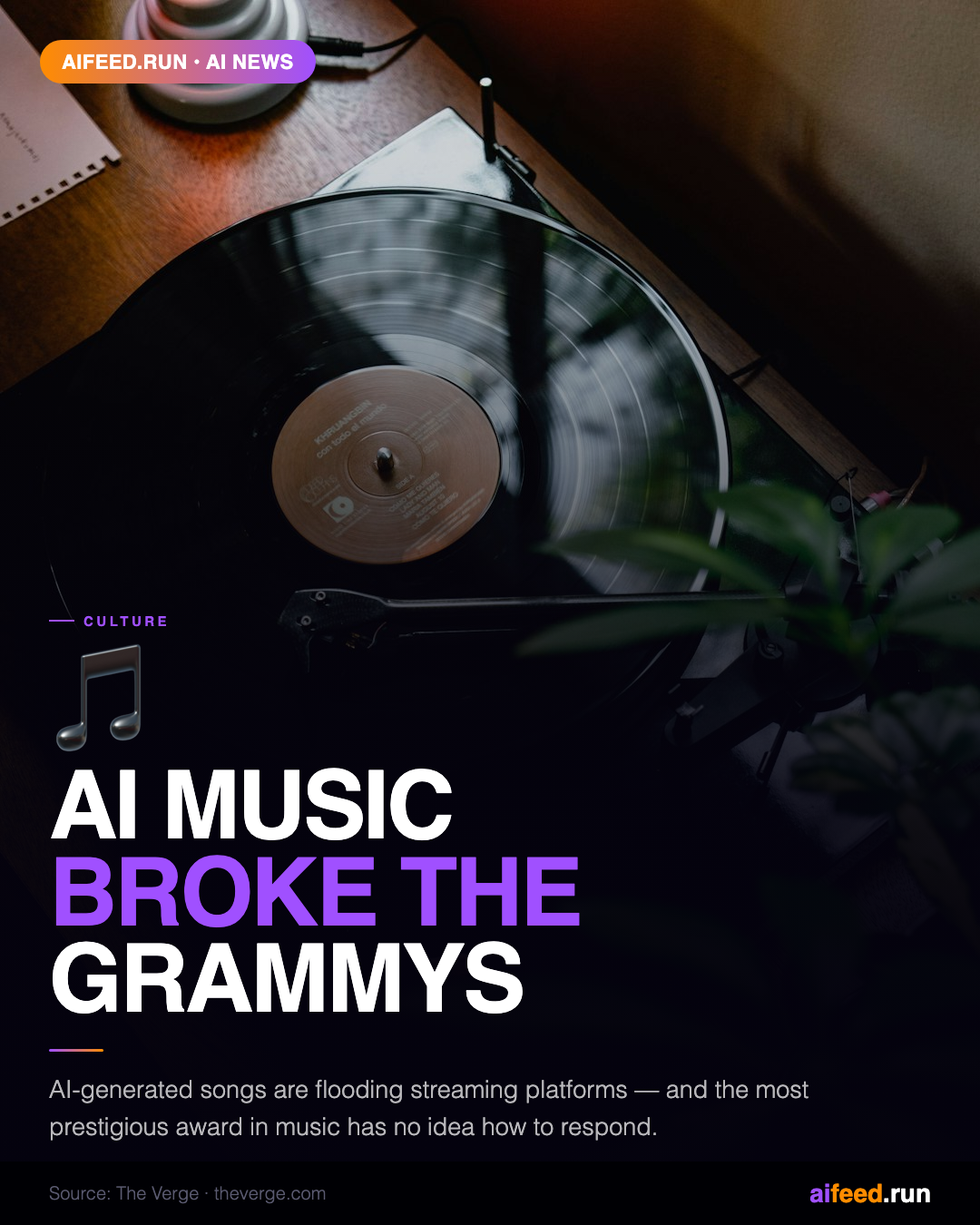
AI Is Blowing Up Music. How Should the Grammys Handle It?
· Industry
AI is generating hooks, cloning voices, and producing full albums — and the Grammys have no idea what to do about it. The music industry's reckoning is here.
AI just walked into the music industry and nobody knows the rules anymore.
Artists are using AI to write hooks, clone voices, and produce entire albums in hours. Some of it is indistinguishable from the real thing. And the Grammys — the most prestigious award in music — have no idea what to do about it.
Do AI-assisted songs qualify? What about tracks where AI wrote the melody but a human sang it? What if the human just hit "generate"? These aren't hypothetical questions anymore — they're happening right now on every major streaming platform.
The music industry spent decades figuring out what counts as a sample, a feature, or a remix. AI makes all of that look simple. The next few years will redefine what it even means to be a musician.
For music industry executives and investors, this is a structural disruption, not a trend. Labels that have historically controlled distribution and production leverage are watching those moats drain. Meanwhile, independent artists with AI fluency can now produce at scale, reaching audiences without traditional gatekeepers.
The deeper question isn't whether AI belongs in music — it clearly does. The question is how creativity, compensation, and credit get allocated when the line between human and machine contribution becomes impossible to draw. Every stakeholder from songwriters to streaming platforms to awards bodies needs a framework, and none of them have one yet.
The Grammys better move fast. The music already has.
`;
}
// ─── HELPERS ─────────────────────────────────────────────────────────
function escHtml(s) { return String(s == null ? '' : s).replace(/&/g,'&').replace(/"/g,'"').replace(//g,'>'); }
function storyImg(p, cls, sizes) {
const url = p.imageUrl || '';
if (!url) return ``;
const m = /^(?:https:\/\/aifeed\.run)?\/?images\/([^\/?#]+)\.(?:png|jpe?g|webp)$/i.exec(url);
const alt = escHtml(p.headline || 'AI news story');
if (!m) return ``;
const t = '/thumbs/' + m[1];
return ``;
}
function imgFallback(el) {
if (!el.dataset.fb) { el.dataset.fb = '1'; el.removeAttribute('srcset'); el.src = el.dataset.full; }
else { el.style.visibility = 'hidden'; }
}
function formatDate(iso) {
if (!iso) return '';
return new Date(iso).toLocaleDateString('en-US', { month: 'long', day: 'numeric', year: 'numeric' });
}
function handleSubscribe(e) {
e.preventDefault();
const email = document.getElementById('inline-email').value;
e.target.reset();
goSubscribe(email, 'article');
}
// One step: the email typed on the page goes straight to Beehiiv's confirm page (no second form).
function goSubscribe(email, source) {
window.__subSource = source;
const url = 'https://magic.beehiiv.com/v1/eb0b9508-1ffd-4fb1-a63c-e762fa86569c?email=' + encodeURIComponent(email)
+ '&utm_source=aifeed.run&utm_medium=website&utm_campaign=' + encodeURIComponent(source || 'site');
// Same tab (no popup: in-app browsers like Instagram's prompt on new windows); Beehiiv sends the visitor to our thanks page after the one tap.
window.location.href = url + '&redirect_to=' + encodeURIComponent('https://aifeed.run/subscribe/thanks/'); return;
try { w.opener = null; } catch (err) {}
document.getElementById('sub-email-field').value = email;
document.getElementById('sub-form-state').style.display = 'none';
document.getElementById('sub-success-state').style.display = 'block';
document.getElementById('sub-overlay').style.display = 'flex';
document.body.style.overflow = 'hidden';
}
function openSubOverlay(email) {
document.getElementById('sub-email-field').value = email;
document.getElementById('sub-form-state').style.display = 'block';
document.getElementById('sub-success-state').style.display = 'none';
document.getElementById('sub-btn').textContent = 'Subscribe — It\'s Free →';
document.getElementById('sub-btn').disabled = false;
document.getElementById('sub-overlay').style.display = 'flex';
document.body.style.overflow = 'hidden';
}
const BEEHIIV_SUBSCRIBE_URL = 'https://magic.beehiiv.com/v1/eb0b9508-1ffd-4fb1-a63c-e762fa86569c'; // Beehiiv public Magic Link for AIFeed.run (pub_eb0b9508-…), no API key
async function submitSubscribe(e) {
e.preventDefault();
const email = document.getElementById('sub-email-field').value;
const btn = document.getElementById('sub-btn');
btn.textContent = 'Opening signup...';
btn.disabled = true;
// Opens Beehiiv's one-click confirm page for this email ("You'll be subscribed with …"). No secret client-side.
const bhUrl = BEEHIIV_SUBSCRIBE_URL + '?email=' + encodeURIComponent(email)
+ '&utm_source=aifeed.run&utm_medium=website&utm_campaign=' + encodeURIComponent(window.__subSource || 'site');
// Same tab (no popup: in-app browsers like Instagram's prompt on new windows); Beehiiv sends the visitor to our thanks page after the one tap.
window.location.href = bhUrl + '&redirect_to=' + encodeURIComponent('https://aifeed.run/subscribe/thanks/'); return;
try { w.opener = null; } catch (err) {}
document.getElementById('sub-form-state').style.display = 'none';
document.getElementById('sub-success-state').style.display = 'block';
}
function closeSubOverlay(e) {
if (e && e.target && e.target.id !== 'sub-overlay' && e.target.id !== 'sub-close-btn') return;
document.getElementById('sub-overlay').style.display = 'none';
document.body.style.overflow = '';
}
function copyLink() {
navigator.clipboard.writeText(window.location.href).then(() => {
const t = document.getElementById('toast');
t.textContent = '🔗 Link copied!';
t.classList.add('show');
setTimeout(() => t.classList.remove('show'), 2500);
});
}
function showToast() {
const t = document.getElementById('toast');
t.textContent = '🎉 You\'re subscribed! Welcome to the feed.';
t.classList.add('show');
setTimeout(() => t.classList.remove('show'), 3500);
}
function getDemoPosts() {
return [
{
id: 'demo-1', slug: 'apple-building-ai-glasses-beat-meta',
headline: 'Apple Is Building AI Glasses To Beat Meta',
summary: 'No screen. Just AI, cameras, and Siri. 4 designs. Premium acetate. Ships 2027.',
body: '
Apple is reportedly developing AI-powered smart glasses designed to compete directly with Meta\'s Ray-Ban AI glasses — and the early details are compelling.
Unlike the Vision Pro, these will have no display at all. Instead, they\'ll rely entirely on AI processing: cameras, Siri integration, and ambient computing. Four frame styles are planned, with premium acetate construction targeting a fashion-forward audience.
The $499 starting price positions them as a premium-but-accessible device — significantly cheaper than Vision Pro but pricier than Meta\'s Ray-Bans. A 2027 launch window gives Apple time to refine the AI stack that will power them.
This move signals Apple\'s belief that ambient AI wearables — not VR headsets — will be the mainstream computing interface of the next decade.
',
category: 'Products', hashtags: ['apple', 'AIglasses', 'meta', 'wearables'],
publishedAt: new Date().toISOString(), imageUrl: ''
},
{
id: 'demo-2', slug: 'google-gemma-4-free-ai-lives-on-phone',
headline: 'Google Gemma 4: Free AI That Lives On Your Phone',
summary: 'Runs locally. Chats never saved. No cloud. Free on iOS and Android right now.',
body: '
Google has released Gemma 4, its most capable on-device AI model yet — and it\'s free on both iOS and Android.
The key differentiator: everything runs locally. Your conversations never leave your device, never hit a server, and are never stored. For privacy-conscious users, this is a significant shift.
Performance gains are substantial. Gemma 4 is reportedly 4x faster than its predecessor and uses 60% less battery — critical specs for a model running continuously on mobile hardware. Google claims it reaches 140 million Android devices immediately at launch.
This puts real competitive pressure on Apple Intelligence and signals that on-device AI is no longer a compromise — it\'s becoming the preferred architecture for consumer AI.
',
category: 'Models', hashtags: ['google', 'gemma', 'mobileAI', 'privacy'],
publishedAt: new Date(Date.now() - 86400000).toISOString(), imageUrl: ''
},
{
id: 'demo-3', slug: 'agi-will-hit-10-revolutions-one-decade',
headline: 'AGI Will Hit Like 10 Revolutions In One Decade',
summary: 'Leading researchers now agree: AGI arrival will compress a century of change into ten years.',
body: '
The consensus among leading AI researchers is shifting from "if" to "when" — and increasingly, the answer is "soon."
A growing number of labs now believe AGI will compress decades of civilizational change into a single decade. Not one industrial revolution, but ten — simultaneously — across medicine, energy, materials science, software, and beyond.
This framing is gaining traction not as hyperbole but as a calibrated forecast from people with direct access to the most capable systems being built today.
What changes first: knowledge work. Then physical labor. Then scientific research itself. The sequencing matters less than the speed.
 `;
}
function imgFallback(el) {
if (!el.dataset.fb) { el.dataset.fb = '1'; el.removeAttribute('srcset'); el.src = el.dataset.full; }
else { el.style.visibility = 'hidden'; }
}
function formatDate(iso) {
if (!iso) return '';
return new Date(iso).toLocaleDateString('en-US', { month: 'long', day: 'numeric', year: 'numeric' });
}
function handleSubscribe(e) {
e.preventDefault();
const email = document.getElementById('inline-email').value;
e.target.reset();
goSubscribe(email, 'article');
}
// One step: the email typed on the page goes straight to Beehiiv's confirm page (no second form).
function goSubscribe(email, source) {
window.__subSource = source;
const url = 'https://magic.beehiiv.com/v1/eb0b9508-1ffd-4fb1-a63c-e762fa86569c?email=' + encodeURIComponent(email)
+ '&utm_source=aifeed.run&utm_medium=website&utm_campaign=' + encodeURIComponent(source || 'site');
// Same tab (no popup: in-app browsers like Instagram's prompt on new windows); Beehiiv sends the visitor to our thanks page after the one tap.
window.location.href = url + '&redirect_to=' + encodeURIComponent('https://aifeed.run/subscribe/thanks/'); return;
try { w.opener = null; } catch (err) {}
document.getElementById('sub-email-field').value = email;
document.getElementById('sub-form-state').style.display = 'none';
document.getElementById('sub-success-state').style.display = 'block';
document.getElementById('sub-overlay').style.display = 'flex';
document.body.style.overflow = 'hidden';
}
function openSubOverlay(email) {
document.getElementById('sub-email-field').value = email;
document.getElementById('sub-form-state').style.display = 'block';
document.getElementById('sub-success-state').style.display = 'none';
document.getElementById('sub-btn').textContent = 'Subscribe — It\'s Free →';
document.getElementById('sub-btn').disabled = false;
document.getElementById('sub-overlay').style.display = 'flex';
document.body.style.overflow = 'hidden';
}
const BEEHIIV_SUBSCRIBE_URL = 'https://magic.beehiiv.com/v1/eb0b9508-1ffd-4fb1-a63c-e762fa86569c'; // Beehiiv public Magic Link for AIFeed.run (pub_eb0b9508-…), no API key
async function submitSubscribe(e) {
e.preventDefault();
const email = document.getElementById('sub-email-field').value;
const btn = document.getElementById('sub-btn');
btn.textContent = 'Opening signup...';
btn.disabled = true;
// Opens Beehiiv's one-click confirm page for this email ("You'll be subscribed with …"). No secret client-side.
const bhUrl = BEEHIIV_SUBSCRIBE_URL + '?email=' + encodeURIComponent(email)
+ '&utm_source=aifeed.run&utm_medium=website&utm_campaign=' + encodeURIComponent(window.__subSource || 'site');
// Same tab (no popup: in-app browsers like Instagram's prompt on new windows); Beehiiv sends the visitor to our thanks page after the one tap.
window.location.href = bhUrl + '&redirect_to=' + encodeURIComponent('https://aifeed.run/subscribe/thanks/'); return;
try { w.opener = null; } catch (err) {}
document.getElementById('sub-form-state').style.display = 'none';
document.getElementById('sub-success-state').style.display = 'block';
}
function closeSubOverlay(e) {
if (e && e.target && e.target.id !== 'sub-overlay' && e.target.id !== 'sub-close-btn') return;
document.getElementById('sub-overlay').style.display = 'none';
document.body.style.overflow = '';
}
function copyLink() {
navigator.clipboard.writeText(window.location.href).then(() => {
const t = document.getElementById('toast');
t.textContent = '🔗 Link copied!';
t.classList.add('show');
setTimeout(() => t.classList.remove('show'), 2500);
});
}
function showToast() {
const t = document.getElementById('toast');
t.textContent = '🎉 You\'re subscribed! Welcome to the feed.';
t.classList.add('show');
setTimeout(() => t.classList.remove('show'), 3500);
}
function getDemoPosts() {
return [
{
id: 'demo-1', slug: 'apple-building-ai-glasses-beat-meta',
headline: 'Apple Is Building AI Glasses To Beat Meta',
summary: 'No screen. Just AI, cameras, and Siri. 4 designs. Premium acetate. Ships 2027.',
body: '